If you're running an online store in Australia right now, you already know how relentless it feels. You're fielding customer enquiries, trying to recover abandoned carts, posting on socials, and managing stock, and somewhere in the middle of all that, you're supposed to be scaling. The last thing you need is a fragmented technology stack that adds to your overheads and operational chaos instead of cutting through it.
That's the honest reality behind why so many Australian eCommerce brands are making the move to a comprehensive Zoho Commerce Implementation in 2026. It's not marketing hype. Merchants are tired of platform lock-in, unpredictable third-party monthly software bills, and fragmented architectures. They are moving to a platform that was built for how online retail actually works today: lean, unified, and highly optimised for profit margins.
Everything from checkouts to multichannel fulfilment – you name it; it affects your profit margins. To protect those margins, progressive online retailers across Australia are consolidating their tech stacks with Zoho Commerce to eliminate redundant software expenses and deliver a seamless customer experience.
Why Traditional Storefront Platforms Are Falling Short?
This is the dilemma with traditional store platforms such as Shopify or WooCommerce in 2026: they created a world where merchants are punished for expanding. While they present themselves as simple, out-of-the-box systems, the reality of running a scaled business on them tells a different story.
Most of the time, these older web platforms introduce severe operational friction:
- The Unfair "App Tax": Want advanced product reviews, wholesale pricing tables, multi-tier discount logic, or comprehensive SEO tools? You have to subscribe to five different third-party apps, adding hundreds of dollars to your monthly overhead.
- Platform Sluggishness: Every third-party app injects external tracking scripts into your theme. This degrades page-load speed, drives up mobile bounce rates, and lowers your Google organic ranking.
- Brittle Integrations: Every time a platform forces a major system update, your third-party applications risk breaking. This requires a dedicated developer and a prayer to fix.
- Compounded Transaction Fees: Standard storefronts take an extractive percentage cut of your hard-earned revenue on top of your payment gateway provider's fees, eating straight into thin retail margins.
Sound familiar? A lot of mid-market Australian eCommerce businesses Melbourne-based fashion labels, Sydney supplement brands, and Brisbane homewares stores hit a financial and operational wall with the tools they started on. They don't struggle because their products lack demand; they face hurdles because their foundational software cuts into their margins.
How a Strategic Zoho Commerce store setup Helps Brands Scale Faster?
Affordable Scaling: 0% Transaction Fees & Balanced Costs
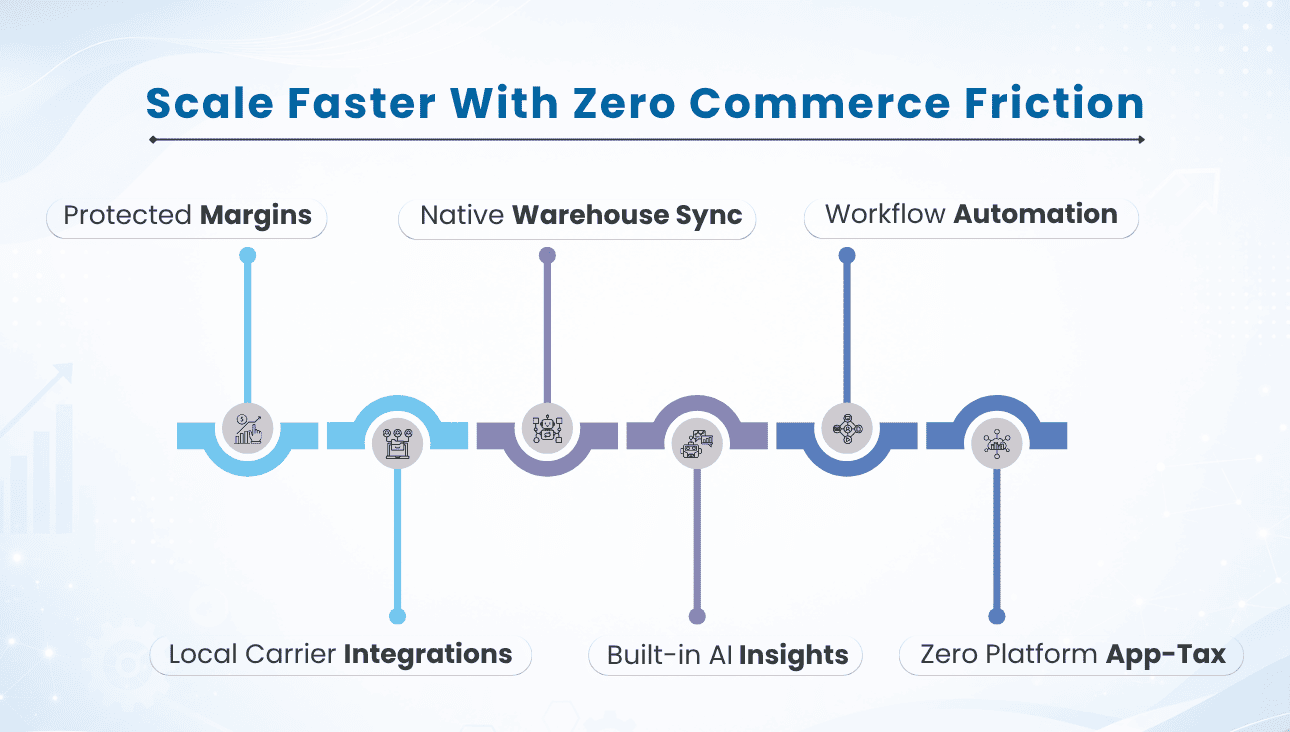
Let's look closely at the math: most mid-sized Australian eCommerce brands aren't in a position to let software vendors extract a variable slice of their top-line revenue. Zoho Commerce does things completely differently by committing to 0% platform transaction fees. Your revenue belongs to you, regardless of whether you process $10,000 or $5,000,000 a month.
- All Come Naturally: Advanced coupon functionality, customer reviews of products, automatic product discounts, and localised tax settings come included in the system. You are not required to pay to overcome the basic restrictions.
- Priced for Sustainable Growth: Zoho's predictable subscription models hold up exceptionally well compared to Shopify Plus or expensive Magento hosting setups, especially when you factor in the total cost of ownership.
A growing retailer scaling their revenue shouldn't be penalised by their software vendor for executing a successful promotion. By partnering with professional Zoho Commerce Developers during your initial launch, you ensure that your technology overhead remains flat as your transaction volume verticalises.
Unified Operations: The Native Inventory & Accounting Sync
Think about how many fragmented tools your backend operational data lives in right now. Your storefront analytics, your fulfilment house spreadsheets, your standalone inventory software, and your Xero or MYOB general ledger. Your staff is constantly switching browser tabs just to perform a basic inventory stock reconciliation.
A successful Zoho Commerce Setup solves this by anchoring directly into a unified ecosystem:
- Real-Time Native Inventory Sync: When an item is purchased online, your stock levels are instantly updated across all your warehouses, sales channels, and brick-and-mortar storefronts via native Zoho Inventory syncing. This eliminates overselling issues.
- Automated Finance Ledgers: Sales totals, multi-state GST allocations, and shipping fees write directly into your accounting ledger (via Zoho Books) without requiring third-party data connectors like Zapier or OneSaas.
Built-in Marketing & Conversion Automation
Zoho Commerce fundamentally changes the playing field by giving lean operation teams the power to control the leverage. The platform features powerful marketing pipelines built directly into the core code, rather than heavy tracking plugins that need to be bolted on.
- Automated Abandoned Cart Recovery: Automatically create multi-stage abandoned cart emails with dynamically generated unique discount codes for abandoned domestic customers.
- Tailored Customer Pricing Profiles: Easily serve up unique pricing models on the exact same storefront asset. Create custom price lists or tier-based rewards for B2B or wholesale customers, which are automatically awarded to customers when they log in.
Omnichannel Selling & Local Multi-Location Fulfilment
Today's Australian consumers are mobile and digital. They find brands on Instagram feeds, check sizing charts on their mobile screens, and compare with what is in store. And this omni-channel shopping journey is wonderfully complemented by an intelligent integration of Zoho commerce with:
- Social Channel Native Commerce: Automatically push and synchronise your live product catalogues straight to Facebook & Instagram shops for seamless engagement on localised social channels.
- Local Click-and-Collect Infrastructure: Set up to 3 different fulfilment points, retail or warehouse points, natively. Let your Sydney or Melbourne buyers have the option of selecting local click-and-collect delivery options right from checkout.
- Local Carrier Integration: Set up to be ready with major regional carriers such as Australia Post, StarTrack, and DHL.
AI-Powered Product Recommendations via Zia
Zoho’s integrated artificial intelligence assistant, Zia, moves past surface-level reporting metrics to actively influence user checkout behaviour directly on your pages:
- Hyper-Personalised Recommendation Feeds: Zia calculates user interaction history, browsing pathways, and macroscopic transaction data to inject dynamic "Frequently Bought Together" cross-sells across product detail pages.
- Traffic Anomaly Detection: The system automatically flags irregular spikes in checkout friction or sudden traffic dips, allowing your digital management team to troubleshoot payment gateways or hosting configurations before your top line takes a hit.
Deep Integration with the Zoho Ecosystem
An enterprise-grade web storefront that requires custom API middleware to connect with your customer service software is an active liability. The platform features plug-and-play architectural synthesis with the entire Zoho ecosystem
Most notably, a dedicated Zoho CRM integration allows you to pass customer purchase history, buying behaviour, and lifetime value metrics straight into your central CRM. This single-vendor ecosystem, transforming your store with tools like Zoho SalesIQ (for direct live-chat conversion) and Zoho Campaigns, turns your digital storefront into an operational command centre.
How Australian eCommerce Brands Are Successfully Adopting Zoho Commerce?
Successful adoption isn't just about moving data; it’s about crafting a digital presence that converts. When brands approach their Zoho Commerce Website Design, they prioritize user experience and backend efficiency in equal measure. A clean, professional Zoho Commerce Store Design is the difference between a high bounce rate and a loyal, returning customer base."
Transitioning your primary web infrastructure properly requires deep operational insight. It is for this reason that it is imperative to collaborate with an experienced Zoho Commerce Consultant with whom you can implement your migration strategy to ensure project success. Downtime risks are reduced, and technical performance is optimised with a strategic implementation expert:
- Deep Operational Discovery: A partner maps out your unique warehouse layouts, tax guidelines, and regional shipping carrier structures before writing a single line of code.
- Clean Catalogue & Asset Migration: Get your historic product databases, customer accounting records, SEO meta descriptions and URL structures safely moved to a new platform without losing your ranking in Google.
- End-to-End Development: Collaborate with the professionals who can deliver tailor-made design solutions for your Zoho Commerce Store and thus make sure that your online store is not only a simple template, but a very fast, responsive resource customized according to your needs.
- Local Continuous Support Frameworks: Get support from professionals located in the same time zone, and receive reliable Zoho Commerce Support whenever you need it most.
Real Business Benefits of Switching to Zoho Commerce in 2026
For Australian online brands that are engaged in groundbreaking seasonal sales events, like End of Financial Year (EOFY) sales, Click Frenzy clearouts and high volume during the Black Friday/Cyber Monday rush, Zoho Commerce offers complete visibility into the inventory assets, operational margins and site performance.
Legacy Storefront Pain Points | The 2026 Zoho Commerce Advantage |
High Revenue Drag: Extractive transaction cuts, in addition to the standard gateway merchant fees. | No Platform Transaction Fees: Maintain healthy margins and predictable top-line growth. |
The "App Tax": The marketplaces are plugin-dependent, with heavy operational fees at their monthly cost. | Native Feature Architecture: Discounts, cart recovery, and reviews are natively built into the core code. |
Asynchronised Backends: Time lag between inventory, sales ledger and CRM profile. | Real-Time Synchronisation: Native ecosystem locking between Zoho Inventory & Zoho Books. |
Brittle Site Codebases: Slower page-load speeds are caused by multiple tracking apps fighting for priority. | Clean, Monolithic Optimisation: Fast layout rendering, higher mobile conversions and cleaner SEO. |
How does Zoho Commerce calculate Australian GST via Zoho Books?
Here is exactly how the calculation and synchronization workflow handles it:
Automated Tax Engine Integration: When a customer places an order on your Zoho Commerce store, the system looks at the customer’s shipping address. If the transaction occurs within Australia, Zoho Commerce references the tax rules defined in your linked Zoho Books organization.
10% GST Application: Zoho Books automatically applies the standard 10% GST rate to taxable items. It can also differentiate between GST-inclusive pricing (where the 10% tax is pulled out of the listed price) or GST-exclusive pricing (where the 10% is added at checkout), depending on how you configure your storefront.
Handling Freight & Shipping Tax: Under ATO guidelines, domestic shipping fees are generally taxable. The system applies the 10% GST to the shipping component automatically, ensuring total invoice compliance.
Real-Time Reconciliation: The second a sale is finalized, a tax invoice is generated in Zoho Books. The GST collected is automatically allocated to your GST Liability Account, making your quarterly Business Activity Statements (BAS) simple to generate without manual data entry or third-party mapping apps.
Conclusion
Scaling a resilient eCommerce brand across Australia in 2026 requires strict fiscal discipline and streamlined operations. The legacy storefront models that relied on stacking dozens of uncoordinated apps onto a basic theme layout are proving too expensive, fragile, and inefficient to sustain at scale.
Zoho Commerce brings together flat, predictable pricing, 0% transaction fees, and deep operational unity in a single ecosystem that fits how modern retail teams actually work. Backed by strategic Zoho Commerce Support from an established local partner, you are doing more than just choosing an online store builder; you are building a scalable operational foundation designed to maximise your profitability. If the cost and performance of your current storefront stack have been on your mind, it is time to have that conversation.
Ready to streamline operations and grow smarter? Flexbox Digital helps premium Australian eCommerce brands implement, migrate, customise, and optimise Zoho Commerce for long-term operational success.