Accurate sales forecasting is not simply a matter of reporting. For Australian businesses, sales forecasting has real-world implications for hiring, cash flow management, inventory purchasing, and investor relations. Yet many businesses still rely on inaccurate spreadsheets or guesses that have little to do with real-world results.
This is where AI-powered sales forecasting in Zoho CRM really makes a difference. By using Zia AI in the Zoho CRM System, businesses are no longer limited to reactive sales forecasting. When used correctly, sales forecasting in Zoho CRM gives sales management a clear idea of future revenues rather than making educated guesses.
In this blog, we’ll break down how Zia works, why forecasting often fails, and how proper Zoho CRM Implementation and Configuration can significantly improve sales prediction accuracy.
What is Zia AI in the Zoho CRM?
Zia is the artificial intelligence assistant embedded within Zoho CRM. It analyses your historical data, pipeline behaviour, customer interactions, and deal movement patterns to generate intelligent insights.
Instead of simply displaying reports, Zia predicts the following:
- Deal closure probability
- Expected revenue timelines
- Sales trends
- Anomalies in performance
- Best times to contact leads
For Australian businesses that use the Zoho CRM for their Business needs, as well as for enterprise-level business needs, Zia works as an intelligent layer that sits on top of the business's CRM. However, the success of Zia depends on the CRM Configuration.
Why Sales Forecasting Fails Without Proper CRM Data and Configuration
As mentioned above, the accuracy of AI-based predictions depends on the data it processes. Therefore, the data in the CRM system should not have any errors or inaccuracies. Otherwise, the sales forecasting accuracy will not be good.
The common mistakes that can result in sales forecasting failures include the following:
- Inconsistent Pipeline Stages
If all the sales representatives have different interpretations of the sales stages, then Zia will not be able to identify any patterns.
- Poor Data Entry Discipline
If the data entry discipline is poor, then the forecasting accuracy will not be good. In this case, the data regarding the size of the deals, closing dates, or contact activity will not be complete.
- No Integration with Other Financial Applications
If the financial applications are not integrated with the CRM system, then the sales forecasting will not be complete. In this case, the Zoho CRM Xero Integration will help in ensuring that the sales deals are properly matched with the invoiced amount.
- No Structured Implementation
If the Zoho CRM implementation is not structured, then the sales forecasting accuracy will not be good. In this case, the Zoho CRM training will help in ensuring that the data accuracy is good.
Key Predictive Models Used in Sales Forecasting
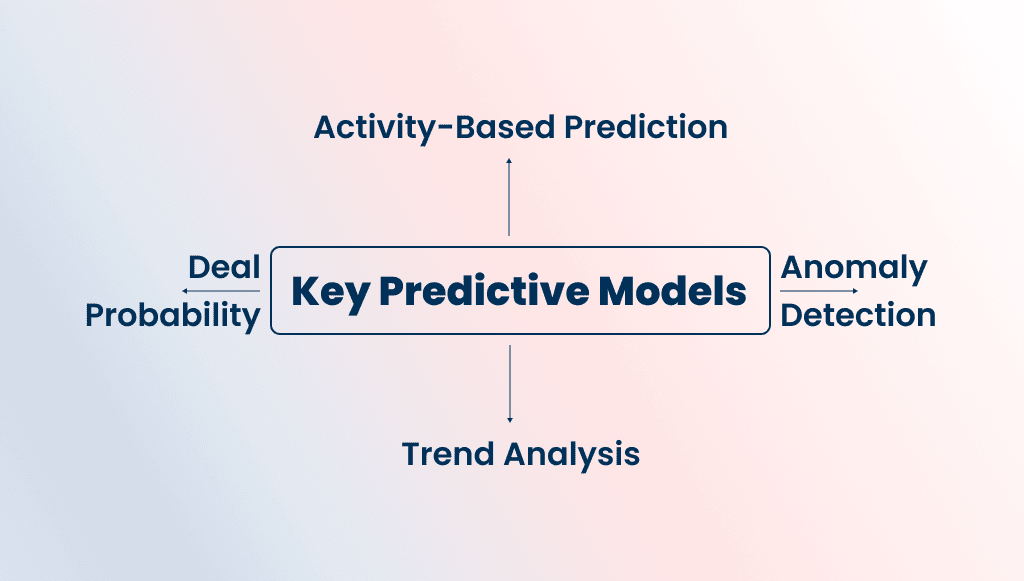
Zia leverages several predictive approaches to generate sales insights.
- Deal Probability Modelling
Zia evaluates historical wins and losses to assign probability scores to active deals.
- Trend Analysis
It identifies seasonal fluctuations and recurring buying patterns. This is particularly useful for Australian industries affected by financial year cycles.
- Activity-Based Prediction
Engages more with higher activity levels and can close faster. Tracks calls, emails, and meetings to get better predictions.
- Anomaly Detection
If a top sales performer suddenly starts to see decreased activity, Zia detects it.
These models continuously learn from CRM behaviour. However, to maximise performance, Zoho CRM Training ensures administrators understand how prediction models are configured and monitored.
How Zia AI Generates Accurate Predictions for Zoho CRM
- The logic that Zia follows is
- It studies the time to close the deals.
- It evaluates the progression of the deals.
- It compares the sales reps' performance.
- It evaluates the activity level of the engagements.
In the long run, it starts to learn the patterns that are industry-specific to your business.
For example, if your business has the tendency to close deals in 45 days after the proposal has been submitted, Zia will consider that in the long run when it starts to make predictions for future deals. Similarly, if some industries have the tendency to take longer to close deals, it will be considered as well in the long run.
But when it is integrated with Zoho CRM and Xero, the reporting that it generates for the revenues is quite powerful because it can match the revenues that it predicts using the actual information provided by the Zoho CRM integration.
Configuring Zia for Accurate Sales Predictions
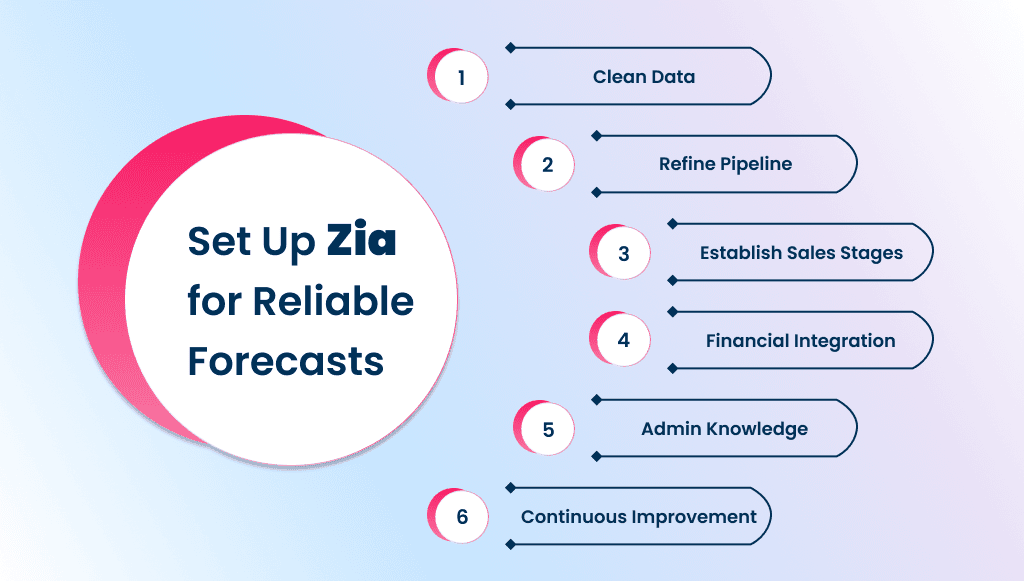
Enabling Zia is not enough. Configuration determines its reliability.
- Step 1: Clean Your CRM Data
Remove duplicates. Standardise deal stages. Enforce mandatory fields.
- Step 2: Refinement of Pipeline Structure
Utilise the Customisation of Zoho CRM to match each stage to your true sales journey.
- Step 3: Establish Sales Stages
Get your sales cycle documented. Your team can be trained formally or via sessions with Zoho CRM Training.
- Step 4: Financial Integration
Integrating Zoho CRM with Xero will mean your forecasts will match up with your records.
- Step 5: Give Administrator-Level Knowledge
An internal employee should take the Zoho CRM Training for Administrator to cover the areas of configuration, automation, and prediction that are needed.
- Step 6: Continuous Improvement
Due to a lack of Zoho CRM Support and Maintenance, frequent issues, inconsistencies, and integration issues can be dealt with promptly.
The accuracy of forecasting can deteriorate without ongoing support from Zoho.
Improving Sales Forecast Accuracy
The collaborative aspect of forecasting should be noted, even with AI included.
- Regular Pipeline Reviews
Hold weekly reviews to validate Zia’s predictions against real-world deal movement.
- Train Sales Teams Properly
Train your team in Zoho CRM Customer Service processes so they record activities, customer conversations, and deal updates in real time.
- Maintain Integration Health
Ensure Zoho CRM Integration remains stable, particularly during financial year transitions.
- Monitor Data Discipline
Assign internal ownership of the CRM to ensure data discipline and accountability.
For advanced configurations or issues with AI, you can contact Zoho CRM Customer Support for assistance. Australian businesses, mostly those that are growing quickly, value reliable forecasting because it aids in effective workforce planning, marketing budget allocation, and strategy for business expansion.
Wrap-Up
Real and actionable forecasting for sales is achieved through Zia AI, which is part of Zoho CRM. However, its scope is limited in terms of structured implementation, customisation, discipline in data, and good connectors for finance applications like Xero.
The ability for businesses to move from a world of guesswork into a world of clarity in terms of their future revenues is achieved through structured administrator-level training, support and maintenance for Zoho CRM. With good configuration and maintenance of your Zoho CRM System, Zia becomes more than an AI assistant. It becomes a reliable forecasting partner that supports smarter business decisions.
Ready to improve your sales forecasting? Flexbox Digital can optimise your Zoho CRM Setup and unlock the full power of Zia AI for Your Business.